HomeBlogsWho Really Decides Your Cancer Treatment Plan? Inside the Tumour Board at Renova
By Renova Hospitals
May 04, 2026
Who Really Decides Your Cancer Treatment Plan? Inside the Tumour Board at Renova
When someone is diagnosed with cancer, the first instinct is often to look for the doctor, the one expert who will take charge and map out the path forward. But modern cancer care does not work that way.
At leading cancer hospitals around the world, and right here in Hyderabad, treatment decisions are no longer made by a single specialist sitting alone with a file. They are made by a team.
That team, and the formal process through which they work, is called a Multidisciplinary Tumor Board. It is one of the most important and least talked about structures in modern oncology.
If you or a loved one has recently been diagnosed with cancer, understanding how a tumour board works could change the questions you ask, the hospital you choose, and ultimately, the quality of care you receive.
What Is a Tumour Board in Oncology?
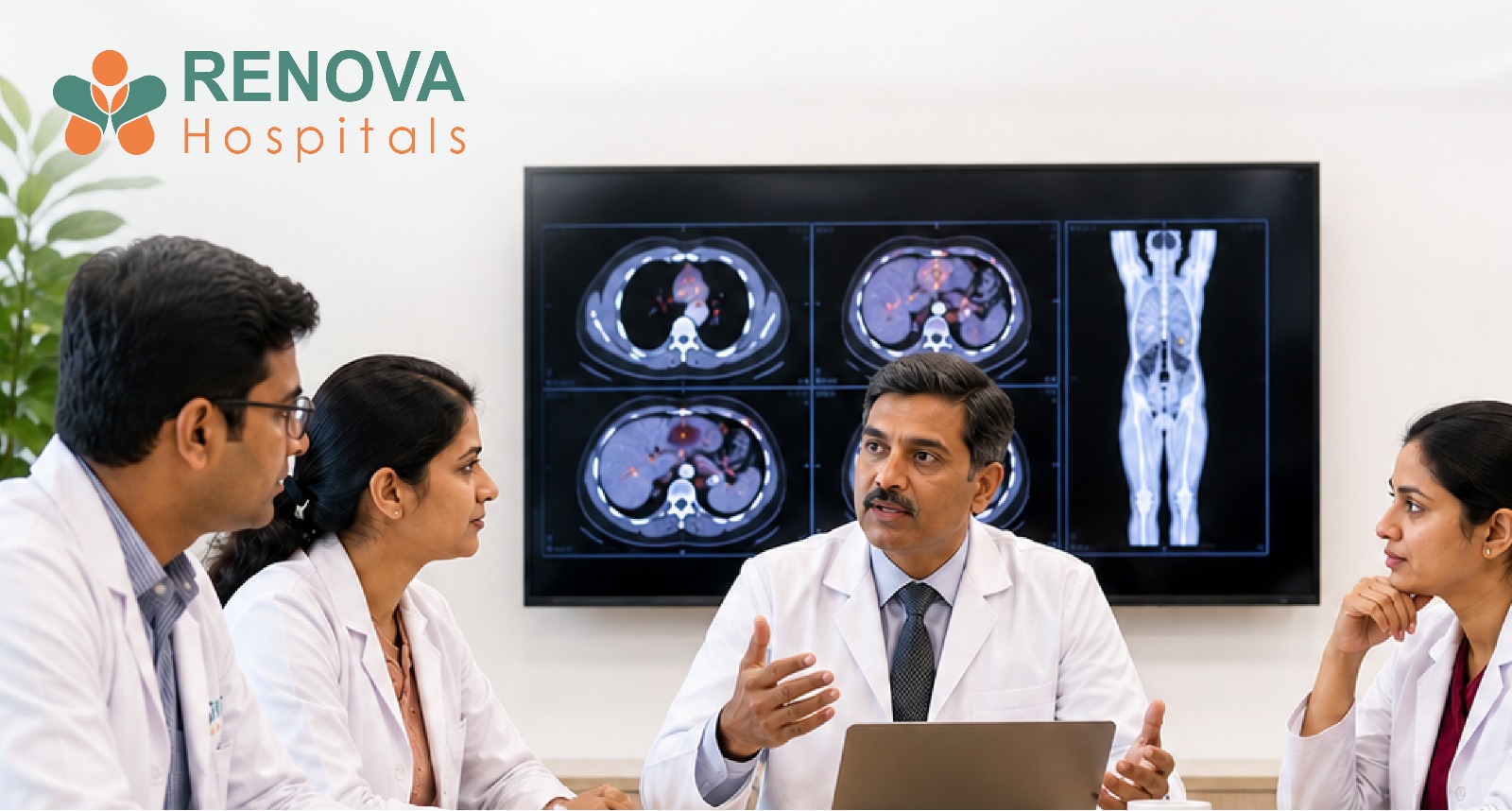
A tumour board is a scheduled, structured meeting where specialists from multiple disciplines come together to review a single patient's cancer case. Everything is on the table:
Biopsy results and pathology findings
Imaging scans and radiology reports
Blood work and lab values
The patient's age, overall health, and personal preferences
The latest clinical evidence and treatment guidelines
The goal is a single consensus treatment plan, built not on the judgment of a single doctor but on the collective expertise of the entire oncology team.
Tumour boards have existed since the 1970s, but widespread adoption as a standard of care is more recent. Today, the following organisations recognise MDT review as a baseline requirement for good cancer care:
World Health Organization (WHO)
American Society of Clinical Oncology (ASCO)
European Society for Medical Oncology (ESMO)
National Cancer Grid, India
At Renova Hospitals in Hyderabad, every new cancer case is reviewed by the tumour board before treatment begins. No plan goes forward without that collective review.
How Many Doctors Are Involved in Treating Cancer?
Depending on the type and stage of cancer, anywhere from five to ten specialists may be involved in your care. Here is who typically sits at the tumour board table:
Surgical Oncologist - Evaluates whether surgery is appropriate, feasible, and likely to achieve clear margins. Determines the safest approach based on tumour location and the patient's fitness.
Medical Oncologist - Leads decisions around chemotherapy, targeted therapy, immunotherapy, and hormone therapy. Often, the patient's primary point of contact is throughout treatment.
Radiation Oncologist - Assesses whether radiation is needed, at what dose, and in what sequence relative to surgery or chemotherapy.
Pathologist - Confirms the diagnosis at a cellular level. Determines tumour type, grade, and the molecular profile that guides targeted treatment decisions.
Radiologist - Interprets CT scans, MRI, PET scans, and ultrasounds. Provides critical information about tumour size, location, and spread.
Onco-Nurse Navigator - Coordinates the patient's journey, ensures nothing falls through the cracks, and serves as the patient's advocate throughout treatment.
Depending on the case, the board may also include a gastroenterologist, pulmonologist, gynaecologic oncologist, reconstructive surgeon, genetic counsellor, or palliative care specialist.
What Actually Happens During a Tumour Board Meeting?
Most patients never see the inside of a tumour board, and that is by design. It is an internal clinical conference. But understanding what happens in that room helps explain why it matters.
Here is how it works, step by step:
The presenting doctor walks the team through the patient's full clinical picture.
The radiologist pulls up the actual scans on screen, not just a written report, and reviews them with the group.
The pathologist presents the biopsy findings live.
The team discusses, debates, and stress-tests every option.
That discussion might sound like this:
The surgical oncologist flags concerns about margins near a critical structure.
The radiation oncologist asks whether preoperative radiation could shrink the tumour first.
The medical oncologist considers whether neoadjuvant chemotherapy achieves the same result with less surgical risk.
The pathologist identifies a molecular marker that makes the tumour sensitive to a specific targeted drug.
This kind of conversation cannot happen through a chain of written referrals. It requires everyone in the same room at the same time.
The meeting ends with a clearly defined plan: the sequence of treatment, each specialist's role, and the reasoning behind every decision. Your treating doctor then communicates this to you, with the full weight of the team's judgment behind it.
How Does a Multidisciplinary Team Actually Help Cancer Patients?
The research is consistent and compelling.
A landmark study found that MDT-based care changed the treatment plan in up to 52% of cancer cases reviewed, compared to what a single specialist had initially recommended.
Research inThe Lancet Oncology found that colorectal cancer patients treated at centres with structured MDT review had significantly better survival outcomes than those managed through single-speciality care.
Here is what specifically changes under MDT care:
Staging becomes more accurate. A radiologist, pathologist, and clinician reviewing together reduces the risk of understaging or overstaging. Treatment intensity is precisely matched to the actual disease burden.
Treatment sequencing improves. Operate first or chemotherapy first? The tumour board resolves this with evidence, not guesswork.
Overtreatment and undertreatment are both avoided. Without MDT review, some patients get more than they need. Others get less. The board calibrates both ends.
Patients are treated as whole people. Age, comorbidities, functional status, and personal preferences all factor in. A theoretically optimal plan that a patient cannot sustain is not a good plan.
The result is not just a smarter treatment decision. It is a plan the entire team stands behind, with better coordination and fewer gaps from diagnosis through to recovery.
Is a Tumour Board Available at Cancer Hospitals in Hyderabad?
India registers over 1.4 million new cancer cases every year, and a significant proportion are diagnosed at an advanced stage, partly because coordinated specialist care has not always been locally accessible.
For decades, patients from Hyderabad and Telangana have had to travel to Mumbai, Chennai, or Delhi for this level of care. That is no longer necessary.
Renova Hospitals operates a fully functional multidisciplinary tumour board in Hyderabad, with specialists across all core oncology disciplines meeting weekly. Here is what that means for patients:
Cases are reviewed, and a treatment plan is finalised within days of diagnosis.
Urgent cases are fast-tracked. The board responds to clinical urgency, not administrative timelines.
Patients from Telangana and Andhra Pradesh access the same standard of care as India's top cancer centres, without leaving the city.
Every plan is documented, communicated clearly, and coordinated across all treating specialists from day one.
You do not need to travel for world-class cancer care. It is here in Hyderabad.
What Should You Ask Your Cancer Care Team?
If you are evaluating where to seek treatment after a cancer diagnosis, ask these questions directly:
Will my case be reviewed by a multidisciplinary tumour board before treatment begins?
Which specialists will be part of my care team?
How quickly will the board review happen after diagnosis?
Will molecular or genetic testing be part of the workup?
Who is my main point of contact, and how will the plan be communicated to me?
A hospital that answers these questions with clarity and confidence is a hospital that takes cancer care seriously. Vague answers or uncertainty about whether a tumour board exists should prompt you to look elsewhere.
The Bottom Line
A cancer diagnosis is one of the most disorienting experiences a person can face. The last thing you need is a treatment plan made in a hurry by a single doctor without all relevant clinical perspectives.
The multidisciplinary tumour board exists to change that. It is not a committee that slows things down. It is the mechanism through which the right decision gets made faster, with more confidence, and with every expert voice accounted for.
At Renova Hospitals in Hyderabad, this is not an aspirational standard. It is the way we work, for every patient, from the moment of diagnosis.
If you have recently been diagnosed with cancer or are seeking a second opinion, contact Renova Hospitals to schedule a consultation. Your case deserves more than one perspective.
Our healthcare specialists are equipped with the
knowledge and skills to provide you with the support you require. From consultation to diagnosis to
treatments, our experts are dedicated to helping you.
Common childhood injuries and ways to prevent them
17 May 2026
|
By
Kids are bustling with energy, zooming in and out of th...
Find quick answers to common questions about our services, doctors, and care at Renova Hospitals. So you can feel informed and confident at every step.
What is a tumour board?
A meeting of specialists from surgery, oncology, radiology, and pathology who review a patient's cancer case together and agree on the best treatment plan.
Who attends a tumour board meeting?
A surgical oncologist, medical oncologist, radiation oncologist, pathologist, radiologist, and nurse navigator. Additional specialists join based on the cancer type.
Does the patient attend the tumour board meeting?
No. It is an internal clinical conference. Your treating doctor presents your case and communicates the agreed plan directly to you afterwards.
How long does a tumour board review take?
An individual case takes 15 to 30 minutes. The full meeting, covering multiple patients, typically lasts one to two hours.
Will the tumour board delay my treatment?
No. At Renova Hospitals, it is built into the diagnostic workflow, speeding up decision-making. Urgent cases are fast-tracked.
What cancers are reviewed by the tumour board?
All solid tumour cancers, including breast, lung, colorectal, head and neck, gynaecologic, and gastrointestinal. Blood cancers follow a separate haematology MDT process.
Can I request a tumour board review for a second opinion?
Yes. If you have an existing diagnosis from another hospital, you can approach Renova Hospitals for a tumour board-based second opinion.
How is the tumour board's decision communicated to me?
Your primary oncologist walks you through the plan after the meeting, covering the reasoning, treatment sequence, and what to expect at each stage.
Does a tumour board exist at cancer hospitals in Hyderabad?
Yes. Renova Hospitals in Hyderabad has a fully operational multidisciplinary tumour board that meets weekly and covers all major cancer types.
Is tumour board review covered under insurance?
It is part of the diagnostic and planning process, not a separately billed service. Your treating team can guide you on what your specific insurance plan covers.